|

Influenced by foreign art theories and local
revolutionary movements, some enlightened painters in the early
twentieth century openly denounced the stereo-typed form of traditional
painting and advocated a new direction in which artists were encouraged
to experiment and to pursue their own personal style.
The 'Three Masters of the Lingnan School',
Gao Jianfu (1879 - 1951), Gao Qifeng (1889 - 1933) and Chen Shu-Ren
(1883 - 1948), were the leading figures in this new art movement. In the
course of their avocation for a reformation on the art of painting, they
succeeded in creating paintings with styles distinctly of their own. The
artistic achievements of the three masters have been widely recognized
as they brought forth a new phase in the development of Chinese
painting. The Lingnan school of painting founded on the basis of the
work of these masters still enjoys a vast following in Hong Kong.
To introduce the artistic achievements of
these Guangdong masters, the Urban Council's Hong Kong Museum of Art
organized an exhibition ' "The Art of Gao Jianfu" last year. This
exhibition, "The An of Chen Shu-Ren", which is presented to coincide
with the Fifth Festival of Asian Arts, will provide a chance for local
and overseas an lovers to get a more comprehensive picture of the an of
another Lingnan master.
Chen Shu-Ren, whose original name was Shao,
alias Nianhua-weixiaozi, Dean-laoren and Ershan-shanqiao, was born at
Mingjing Village of Panyu District in the Guangdong Province. At the age
of seventeen, he studied painting under Ju Lian, the great flower
painter of Guangdong. Later he went to Japan twice for further study. In
1906 he entered the Kyoto Art Academy, and in 1913 he studied for the
degree of the Bachelor of Arts at the Rikkyo University, Tokyo. Chen is
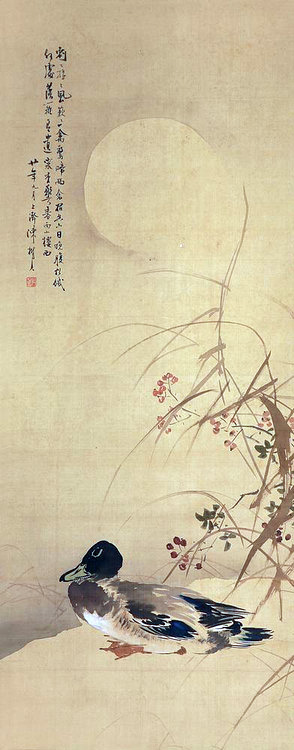
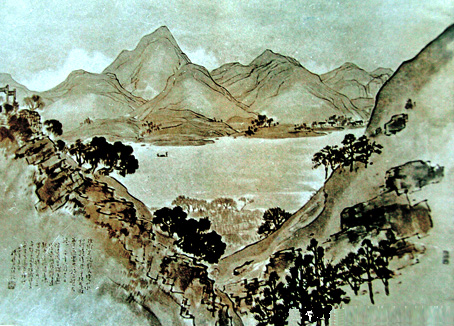
well-known for his bird-and-flower, landscape and animal paintings.
Though the influence of his teacher and the style of Nihonga can still
be seen in some of his earlier works, yet he had successfully developed
his own style of paintings by his middle age.
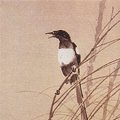
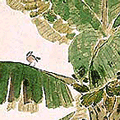
In this exhibition, one can easily sense the
quiet and yet animated verve of the artist. He did not place emphasis on
complexity of pictorial content or astounding techniques but he did try
to free himself from the restraints of traditional painting. The images
of his paintings are simple and straightforward, and so is the form of
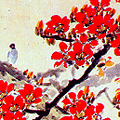
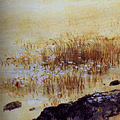
his brushwork. In painting rocks, he tried to keep the use of
traditional textural strokes to the minimum. In painting flowers, he
applied colours directly onto the painting surface to achieve the
desired tones and shapes at the same time without resort to the use of
outlines. The new compositional formats of many of his paintings and his
personal style of brushwork combined to make him one of the outstanding
Chinese painters in the early pan of this century.
Besides being an outstanding artist, Chen
was also an active member in the political circle. He assisted Dr. Sun
Yixian, father of the Chinese Republic, in his revolutionary campaign
from its onset. After the establishment of the Chinese Republic, he held
various important offices in the government including the Minister of
Civil Affairs in Guangdong and Head of the Committee for Overseas
Chinese Affairs. Although he was assiduously engaged in political and
administrative affairs, he never gave up his pursuit in an. In his
career, we see the dual success of a politician and an artist.
 We are most grateful to Mr. Chen Shih, who is the son of the artist, for
providing us with most of the exhibits from his family collection. Our
gratitude is also due to Mr. Au Yeung Lun, Mr.ChaoShao-an, Mr. Chow Kam-wing,
Mr. Huo Pao-tsai, Mr. Kao Li-chieh, and Mr. Kong Chung, Mr. Lai Ming,
Mr. Lee Kiu-fong, Mr. Ng .Wai-kai, Mr. Tseng Tso-yam, Mr. Young Sing-sum
for the generous loan of their valuable collections, and to Mr. Chuang
Shen, Head of the Department of Fine Arts of the University of Hong
Kong, for contributing an article on the an of Chen Shu-Ren for the
catalogue. My thanks goes to all my friends and members of staff of the
Museum who kindly assisted in the preparation of this exhibition.
We are most grateful to Mr. Chen Shih, who is the son of the artist, for
providing us with most of the exhibits from his family collection. Our
gratitude is also due to Mr. Au Yeung Lun, Mr.ChaoShao-an, Mr. Chow Kam-wing,
Mr. Huo Pao-tsai, Mr. Kao Li-chieh, and Mr. Kong Chung, Mr. Lai Ming,
Mr. Lee Kiu-fong, Mr. Ng .Wai-kai, Mr. Tseng Tso-yam, Mr. Young Sing-sum
for the generous loan of their valuable collections, and to Mr. Chuang
Shen, Head of the Department of Fine Arts of the University of Hong
Kong, for contributing an article on the an of Chen Shu-Ren for the
catalogue. My thanks goes to all my friends and members of staff of the
Museum who kindly assisted in the preparation of this exhibition.
Laurence C.S. Tarn
Curator Hong Kong Museum of Art October, 1980
Biography >>
|