|
|
|||||||||||||||||||||||||||||||||||||||||||||||||||||||||||||||||
|
|
|||||||||||||||||||||||||||||||||||||||||||||||||||||||||||||||||
|
| LINGNAN SCHOOL | THE HISTORY | THE ROOTS | JAPANESE CONNECTION | LINGNAN MASTER |
So spectacularly successful had been Japan's modernization in the Meiji period that the Japanese were convinced that they had found the solution to the problem of how to adapt Western culture to East Asia, and they saw themselves as leading the way for the other cultures. Inspired by Fenollosa and his disciple Okakura Kakuzo, Japanese artists had combined traditional Japanese techniques - particularly those of the Kano School, marked by a propensity for smooth surfaces and decorative effects - with Western realism and a more contemporary subject matter to create nihonga, or "Japanese painting." Though many of the Chinese pioneers of modern art studied in Japan, it was the brothers Gao Jianfu and Gao Qifeng, with Chen Shuren and their friends and pupils, all Cantonese, who brought the nihonga style to China and dedicated themselves to the creation of a New Chinese Painting (xin guoliua).
In 1903 Gao Jianfu went to Canton, where his horizons began to broaden under the patronage of the painter and collector Wu Deyi, who introduced him to works in the great tradition. He entered the Canton Christian College (later Lingnan University and then National Sun Yatsen University), where he encountered a French teacher of painting known only by his Chinese name, Mai La. More important was his meeting with one of the many Japanese teachers then in China, Yamamoto Baigai, who fired him with the ambition to study in Japan and taught him the rudiments of the language. In the winter of 1906 he left for Tokyo. Cold, hungry, and almost destitute, he was rescued there and restored to health by his revolutionary friend Liao Zhongkai. After returning to Canton for the summer holiday, he went back to Tokyo in 1907, taking his nineteen-year-old brother Qifeng with him.
In the meantime Chen Shuren, more politically conscious, was working for an anti-Manchu newspaper in Hong Kong. When Sun Yatsen's revolutionary Tong Meng -Hui was formed in] 905 he became a member and a close associate of leading Cantonese revolutionaries, including Liao Zhongkai and Wang Jingwei. He spent 1906-12 in Kyoto and 1913?6 in Tokyo, then devoted himself increasingly to politics. Sun Yatsen sent him to Canada in 1917 to head the Canadian branch of the Guomindang.
It is said that when Gao Jianfu first began to study in Tokyo it was Western art that attracted him, and that he joined societies formed to promote it. His surviving works from the period, however, show little evidence of such enthusiasm. The most obvious and consistent influence in his early work is that of leading nihonga painters Kano Hogai, Hashimoto Gaho, and Takeuchi Seiho, which lie absorbed during two years of very intense study in Tokyo, although it is not clear whether lie studied in the official Tokyo School of Fine Arts (Tokyo bijutsu gakko) in Ueno Park or in the independent Japan Fine Art Institute (Nihon bijutsu in), founded by Okakura Kakuzo. Croizier in his study of his Lingnan School thinks the latter more likely, and in any case it would have been difficult for a Chinese, newly arrived, a stranger to the land and almost to the language, to gain admittance to the prestigious national academy. Gao Jianfu may also have spent some time in Kyoto, for his style shows that he was as much influenced by the masters of the Maruyama-Shijo School, Maruyama Okyo and Matsumura Goshun, as he was by the nihonga pioneers in Tokyo. Chen Shuren, who also studied in Kyoto for a time, felt that influence even more directly.
These artists believed passionately that they could create a new Chinese art through a synthesis of East and West. Here Gao Qifeng explains his purpose:
The student of art must try to adopt a much loftier viewpoint and imagine himself charged with an altruistic mission which requires him to consider his fellows' miseries and affliction as his own. He will then work hard on the production of only such pictures as will effect a betterment of man's nature in particular and bring about an improvement of society in general, thereby presenting the new spirit of the art in all its glory and grandeur.
Here Gao Qifeng echoes Fenollosa, who claimed that the nihonga, which he helped to create, would "dominate all Japan in the near future and . . . have a good influence over the world."
Gao Jianfu returned from Japan in 1908. After a stay in Canton, where lie held a one-man show, he went to Shanghai in 1912 and at once plunged into its cultural life. After starting a hand-decorated ceramics business - one of his pieces won a prize in 1912 at the Panama Ex-position - he set up the Aesthetics Bookshop (Shenmei shuguan) and launched Zhenxiang huabao (The true record), a magazine that ranged over politics, industry, society, and art and was well illustrated with photographs and reproductions, many of them the Lingnan painters' own works (fig.1 >>). Although it ran for less than a year, Zhenxiang huabao broke new ground as the first of many journals to bring art to the literate public. Liu Haisu, in 1912 a sixteen year old just embarking on his life as a painter, later remembered that Shenmei Shuguan was the first place in Shanghai, other than traditional mounting shops, where paintings were publicly sold.
Chen Shuren, by contrast, stayed at the center of political affairs after his return from Canada in 1922, holding a number of government posts, which eventually took him to Nanjing. As a painter he remained an amateur, less confined by style and doctrine than the Gao brothers. Consequently, after an initial "Japanese" phase, his later works are either traditional or conventional or show a hint of Western realism, absorbed with apparent lack of conscious intent. He sketched constantly in the open air, in pencil or color, so his later landscapes based on his sketches are generally closer to nature, less contrived, than those of the Gao brothers. His easy, assured brushwork suggests the work of an amateur painting not to convey a message or demonstrate a theory but simply because he enjoyed it fig. 2 >>. His poems are described by Lawrence Tam as "plain and straightforward, elegant and sincere" ?qualities that mark his later paintings as well, and qualities one seldom finds in the work of the Lingnan painters. In 1923 the Gao brothers established their Spring Awakening Art Academy (Chunshui huayuan) in Canton. Now at last they were able to promote their own Chinese version of the nihonga. Among friends and com-patriots, free of competition from the powerful Shanghai School, the Chunshui Academy flourished. Gao Jianfu was also tireless in organizing exhibitions and art associations. In 1930 he went on a long tour of India that took him to the Ajanta caves, to Nepal, and to a meeting with Rabindranath Tagore in Calcutta. Al-though he later painted some pictures inspired by Indian themes - copies of the Ajanta wall paintings, the Ganges at dusk, a conventionally melancholy (and very Japanese) view of ruined stupas - the effect of his Indian sojourn seems rather to have deepened his leaning towards Buddhism and things spiritual. Late in life he was a frequent visitor to a Buddhist temple in Guangxi, whose abbot dedicated a pavilion to him for his own use. Gao Jianfu often painted flowers, plants, and grasses in his own version of the Chinese literary style, and occasionally - perhaps to establish his credentials with those who did not care for the Japanese element in his work - he painted landscapes in the orthodox tradition of Tang Yin and Lan Ying. After his early birds, flowers, and plants in the Ju Lian manner, though, most of his works are consistently synthetic, with a smooth finish and artificial sfumato effects (fig. 3 >>). He loved sunsets and twilight moods, as shown in his painting of the Five Story Pavilion in Canton of 1936, while his penchant for conventional Japanese themes appears in his monkeys and owls in the trees silhouetted against the moon. Even his rendering of so thoroughly Chinese a subject as the burning of Qin Shihuangdi's A-pang palace is based on a Japanese treatment of the theme. The influence of Takeuchi Seiho and other nihonga painters is also obvious in the lions and tigers as symbols of patriotic vigor that the Gao brothers and Chen Shuren liked to paint early in their careers.
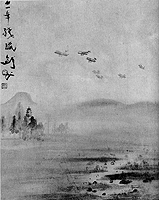
The Gao brothers were nothing if not patriotic - and modern, after their fashion. When flying was still a dangerous pastime in China, Gao Jian-Fu made sketches from an airplane; he used them in Flying in the Rain (fig. 4 <<), a scroll showing a squadron of biplanes flying over a misty ink wash landscape with a pagoda, and in Two Monsters of the Modern World, a tank in a landscape with an air-plane hovering overhead. A number of these airplane paintings were exhibited in Canton in 1927, accompanied by a banner bearing Sun Yatsen's slogan, "Aviation to Save the Country." When war came in 1937. Gao Jianfu and his former students, such as Seeto Ki (Situ Qi), were well prepared to depict the Japanese bombing and the ruin of cities.
Realism of a less contrived sort was practiced by Gao Jianfu's pupils Guan Shanyue, whose Waterwheel in Sichuan is reproduced here (fig. 5), and Fang Kending, who studied in Japan from 1929 to 1935. On his return Fang contributed to an exhibition over a hundred paintings, chiefly figure subjects. Croizier divides them into the realistic -"ordinary people in ordinary situations"'- and the romantic - "sweet-faced Japanese farm girls, languorous nudes, and mythological scenes" .1" He was praised by some critics for reviving figure painting and attacked by others for being too Japanese, one calling his work a hopeless mishmash of conflicting styles. When the People's Republic came to power he was able to make the necessary stylistic adjustments with little trouble.
A more forceful follower of Gao Jianfu is Li Xiong-Cai. He is above all a landscape painter, noted for often dramatic compositions marked by dense textures, strong chiaroscuro, and rather un-Chinese color effects. Richly realistic in detail, his style too adapted easily to the romantic realism of China after 1949.
It may be wondered why Gao Jianfu's lead was not followed more widely than it was, given the thorough technical training lie advocated and his sincerity and dedication to the creation of a new school of art for China based on a synthesis of the best from East and West. To begin with, at least, a number of critics and painters praised him. Xu Beihong saw him as the "forerunner of the revival of Chinese art." Wen Yuanning, the realist Ni Yide, and even the fastidious Fu Baoshi lauded the courage with which lie had thrown off the fetters of hackneyed styles and subject matter." Whatever one might think of much of the work of the Lingnan painters - and I must honestly declare my antipathy - it at least focused the minds of many young Chinese artists on the problem of the East-West synthesis and showed one approach to a solution.
But there are reasons why the appeal of the Lingnan movement was always limited. To begin with, it was just getting under way when waves of anti-Japanese feeling were sparked by Japan's notorious Twenty-one Demands of 1915 and intensified by the May Fourth Movement, and later by Japanese aggression in China. This, we might say, was just Gao Jianfu's bad luck. Secondly, the Lingnan pai, as the name implies (Lingnan means "south of the mountains," in reference to Guangdong Province and the city of Canton), was essentially a local school. It had little or no influence outside Guangdong.
The conservative inheritors of the literary tradition, dismissing the Lingnan School as "cheap imported Japanese goods," may well have looked on it as a more insidious threat to the purity of Chinese painting than was the outright challenge of Western art, while by the 1920s artists who wanted Western art wanted it pure and from Paris, not in Tokyo's diluted form. But perhaps the most cogent reason for the school's never catching on was that it was based on a misconception of the nature and purpose of art. Good art is produced not by lofty aims or fine technique, or even by a combination of the two, but by that passion for form which at the moment of painting excludes all other considerations. It is the lack of that passion, the utter impersonality of their work, that in the end robbed the Gao brothers and many of their followers of a dominant role in modern Chinese painting.
|
|||||||||||||||||||||||||||||||||||||||||||||||||||||||||||||||||
|
|||||||||||||||||||||||||||||||||||||||||||||||||||||||||||||||||








 In
1892, as a boy of thirteen, Gao Jianfu entered the studio of the professional
painter Ju Lian in Lishan, where he served his apprenticeship for the next
seven years, painting chiefly birds and flowers, grasses and in-sects, in
the careful, realistic, brightly colored style of his master. Chen Shuren
as well was close to Ju Lian, eventually marrying his grandniece, and Gao
Qifeng may also have studied briefly with him. It was in Ju Lian's studio
that Chen Shuren met Gao Jianfu, sometime between 1902 and 1909, and they
remained friends until Chen's death in 1948.
In
1892, as a boy of thirteen, Gao Jianfu entered the studio of the professional
painter Ju Lian in Lishan, where he served his apprenticeship for the next
seven years, painting chiefly birds and flowers, grasses and in-sects, in
the careful, realistic, brightly colored style of his master. Chen Shuren
as well was close to Ju Lian, eventually marrying his grandniece, and Gao
Qifeng may also have studied briefly with him. It was in Ju Lian's studio
that Chen Shuren met Gao Jianfu, sometime between 1902 and 1909, and they
remained friends until Chen's death in 1948.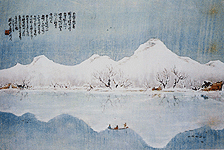 Gao
Jianfu was even more ambitious when he wrote, "I think we should not only
take in elements of Western painting. If there are good points in Indian painting,
Egyptian painting, Persian painting, or masterpieces of other countries, we
should embrace all of them, too, as nourishment for our Chinese painting."
but the ideal-ism of the Lingnan artists reached far beyond the mere creation
of a new school of painting. Gao Qifeng again:
Gao
Jianfu was even more ambitious when he wrote, "I think we should not only
take in elements of Western painting. If there are good points in Indian painting,
Egyptian painting, Persian painting, or masterpieces of other countries, we
should embrace all of them, too, as nourishment for our Chinese painting."
but the ideal-ism of the Lingnan artists reached far beyond the mere creation
of a new school of painting. Gao Qifeng again: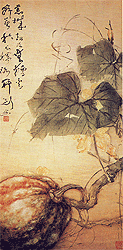 The
Gao brothers continued to teach and paint in Shanghai until 1918, but Gao
Jianfu always felt some-thing of a stranger in this region, where the Shanghai
school of painting was so firmly entrenched. When Sun Yat-Sen appealed to
him to join the Canton government as a member of the Guomindang Industrial
Art Commission and head of the Provincial Art School, it was an opportunity
he could not resist. Gao Qifeng also took up a teaching career in Canton.
The
Gao brothers continued to teach and paint in Shanghai until 1918, but Gao
Jianfu always felt some-thing of a stranger in this region, where the Shanghai
school of painting was so firmly entrenched. When Sun Yat-Sen appealed to
him to join the Canton government as a member of the Guomindang Industrial
Art Commission and head of the Provincial Art School, it was an opportunity
he could not resist. Gao Qifeng also took up a teaching career in Canton.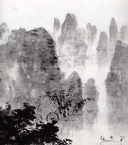 Most
consistent in his adherence to his nihonga back-ground, and particularly to
the style of his master Tanaka Kaislio, was Gao Qifeng. In 1929 lie moved
into a house in Canton which he called the Heavenly Wind Pavilion (Tianfeng
Lou), where he taught till his early death from tuberculosis in 1933. His
favorite student, ZhangKunyi, left her own husband to move in as his nurse
and adopted daughter and perhaps also his mistress, an arrangement that caused
some scandal at the time. She was herself a moderately talented painter and
the devoted custodian of his memory, writing his funeral eulogy; it was said,
in her own blood.
Most
consistent in his adherence to his nihonga back-ground, and particularly to
the style of his master Tanaka Kaislio, was Gao Qifeng. In 1929 lie moved
into a house in Canton which he called the Heavenly Wind Pavilion (Tianfeng
Lou), where he taught till his early death from tuberculosis in 1933. His
favorite student, ZhangKunyi, left her own husband to move in as his nurse
and adopted daughter and perhaps also his mistress, an arrangement that caused
some scandal at the time. She was herself a moderately talented painter and
the devoted custodian of his memory, writing his funeral eulogy; it was said,
in her own blood.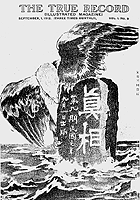 The
Chunshui Academy continued to flourish until the Japanese occupation of Canton
in 1938 drove it to Macao, where Gao Jianfu kept the school barely alive until
it could be reestablished in Canton in 1945. When "Liberation" closed all
private art schools in 1949, Gao Jianfu took his academy back to Macao once
more. He died there on May 22, 1951, not long after his big retrospective
at the Zhongyang Hotel.
The
Chunshui Academy continued to flourish until the Japanese occupation of Canton
in 1938 drove it to Macao, where Gao Jianfu kept the school barely alive until
it could be reestablished in Canton in 1945. When "Liberation" closed all
private art schools in 1949, Gao Jianfu took his academy back to Macao once
more. He died there on May 22, 1951, not long after his big retrospective
at the Zhongyang Hotel.