|
|
||||||||||||||||||||||||||||||||||||||||||||||||||||
|
|
||||||||||||||||||||||||||||||||||||||||||||||||||||
|
Selected Articles
Ink-Wash Master Au Ho-Nien
(Anna Wang/pictures courtesy of Au Ho-Nien / tr. by Christopher MacDonald)
The amazing thing is that Au, whose work verges on perfection, is still producing prolifically. He paints for hours every day, and goes on several trips a year so that he can paint from nature. Au feels that the art of painting knows no bounds, and that like good wine, it is something that gets better with age. From June 30 the main display hall of the Sun Yat-sen Memorial Hall in Taipei will host a 17-day exhibition of paintings done by Au during the past ten years. People who love ink-wash will be able to experience first-hand the brilliance of a painter of whom Chang Ta-chien once wrote: "When he wields his brush, he seems to have the power of a creator in control of all the manifestations of nature."
A painter with the bearing of a master, one can almost hear birdsong sounding through the mountains/ As he rises aloft to the Milky Way, he looks back on the innumerable peaks below . . . (Chao Shao-Ang)
Thirty years ago Au Ho-Nine, mentor Chao Shao-Ang, whose paintings of flora and fauna had raised the Lingnan school of painting to new heights of achievement, penned this verse in praise of his brilliant disciple. At that time, Au had just settled in Taiwan at the invitation of Chang Chi-yun, the founder of Chinese Culture University. Au didn't let his mentor down, producing innumerable paintings and gaining international renown in the following three decades, carrying forward the development of the Lingnan school and helping it to achieve the status of one of the major schools of painting in the history of Chinese art.
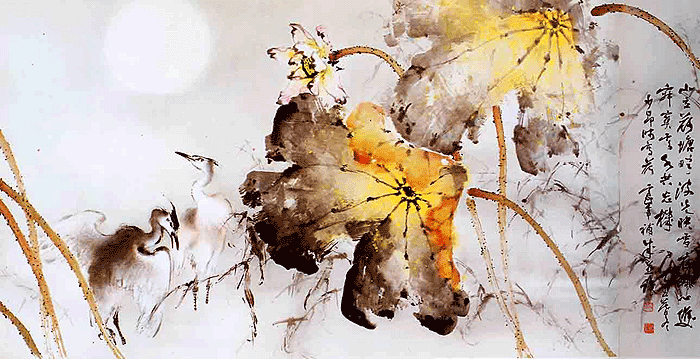
Heroic and stately spirit In recent years there has been a drive for innovation within the field of ink-wash painting, with artists fusing ideas from East and West and subverting tradition, all in pursuit of a creative breakthrough. But in the process, the traditional three-fold character of Chinese ink-wash, the scholar-artist's combination of poetry, calligraphy and painting, has been lost. Looking at the work of Au Ho-Nien, however, one is instantly captivated by his vivid landscapes, lifelike fauna and distinctively individual human figures, along with the verse inscriptions added in his forceful calligraphy, and the way that the painted and blank areas of his pictures are so perfectly set off against one another. Through the artist's piercing eye, Nature, in all her endlessly changing variety, is depicted in a way that not only tells of Nature's essential beauty, but also fully reflects the feelings and thoughts of the painter. Au's work can truly be said to embody the essence of the Lingnan school, elevating the traditional art of Chinese ink-wash painting to new heights. Little wonder that one Japanese collector had the structure of his hall altered to accommodate one of Au's larger works. Japanese art critic Uemura Taka Ink-Wash Master Au Ho-Nien chino has written of Au: "While expressing a contemporary feel, his work also gives people a sense of the heroic and stately spirit of the Chinese."
As many people know, besides hailing from the Lingnan School of painters, Au also has a solid grounding in the classics of Chinese literature. In fact painting was not something that he studied much of as a boy. But his father had many literary and artistic friends, and a large collection of paintings and calligraphy, and young Au was always interested in literature and art, and gradually his tastes became more and more refined. Both gifted and hard-working, Au says: "You make your own luck in this world. Who gets anywhere relying on 'nurture' alone?" However, even the most gifted of people need the guidance of a good teacher at some point. Au and his family were lucky to move to Hong Kong before the Communist takeover on the mainland, and in 1952, when Au was 17, he began studying under Chao Shao-Ang, the leading light of the Lingnan school. The vibrant spirit of the Lingnan school suited him perfectly. He threw himself into his painting and was soon producing work of real quality. In his early twenties his name began to be known in art circles, and he exhibited in a show that toured the Southeast Asia region. By the time he moved to Taiwan, in his early thirties, he was already famous.
Au, who has a generous, outgoing nature and is friendly and unassuming in person, does not consider himself a "genius." He simply acknowledges that he has an intense thirst for knowledge and a love of learning, and that he is devoted to the art of painting. To this day he still paints continuously, and says that his biggest worry is that he'll start painting with such facility that he becomes complacent, and stops making progress. Every year he sets off on several painting expeditions, and keeps his implements to hand so that he is ready to stop and paint whenever he wants to. When he visits somewhere like Mt. Huangshan in mainland China, he likes to seek out stirring scenery and paint it in detail. But sometimes he may be taken by a momentary sight, such as a glimpse of the Arctic through the window of an airplane, and make a quick sketch which may or may not be elaborated on later. As Au turns the pages of his self-made portfolio-type sketch book, vivid images of scenic places such as Huangshan, Guilin and Jiuzhaigou pass before one's eyes, every one a testament to Au's masterly facility with the brush.
With regard to brush technique, coloring and composition, Au says that a painter has to master these in his youth. "Nurture a flexible brush style when young, and from your middle years onwards develop countless variations in that style, variations that are inseparable from the thinking of the artist. Then, when older, simply follow your inclinations, free of restrictions." But how does a painter reach such a realm? You have to refine and improve yourself as time goes by. A little story that Au mentions in passing shows how much of himself he puts into his art. During the eight years when he was courting his future bride Chu Mu-lan, who was another of Chao Shao-ang's pupils, he made frequent visits to the home of the Chu family, where he did a lot of painting. One large picture that he completed at the home of the Chus, about two meters square, is entitled "Pair of Lions." Au's wife chuckles: "It shows two lions at the edge of a precipice, which were the two of us he said. But the lioness is in front with the male lion hiding behind her-needing my protection!" Au and his wife share the same path in life, and they have held more than a dozen joint exhibitions of their work. Their conjugal affection and ability to learn from each other is surely one of the factors that have enabled Au to enjoy such a flourishing artistic career.
Chinese and Western influences
The Lingnan school was founded in the late Qing dynasty by painters Gao Jianfu, Gao Qifeng and Chen Shuren. Chao Shao-ang was Gao Qifeng's protege, and seeing an exhibition of Chao's had a profound impact on Au when he was a youth. Though now a leading painter in his own right, Au has remained true to the artistic course charted by his predecessors in the Lingnan school, combining vivid realism with free expression. Whether rendering the depth of field and play of light in a landscape painting, or depicting the sinews, physique and bearing of an animal, the Lingnan painters bring their subjects to life in a very effective way. The Lingnan school has thus risen in prominence to occupy a prime position in the recent history of Chinese painting, following on from the late-Qing dynasty Haishang school of painting.
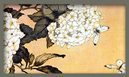
To properly understand Au's work it is necessary to know something about the unique style of the Lingnan school. The catchphrase of the school's painters was: "Drawing on influences from China and the outside world, merging elements from ancient and modern times," and the method they used to achieve this was: "Taking Nature as one's master, and emphasizing the art of painting from life." The school's three co-founders all started out with a solid grounding in ink-wash painting, spent time studying in Japan, and mastered the Western art techniques of sketching, life painting, shading, palette and perspective. Gao Jianfu stressed: "You have to be faithful to Nature when seeking subjects to paint from life, but that doesn't mean blindly obeying Nature. You need your own ideas, and a vision that has been refined through your own soul, so as to determine the aesthetic of a picture and strengthen the overall effect." One characteristic of the Lingnan school is the flexible application of different brush techniques, allowing for variety in the depiction of mountains, trees and rocks for example. This gives paintings from the Lingnan school a feeling of great immediacy, with vividly rendered landscapes featuring precipitous, imposing mountain scenes. The essence of the Lingnan style is captured in Au's paintings of Huangshan and the Yellow River. Another feature of Lingnan paintings is their brightness and density of color, which reflects the influence of Impressionism on the school. The emphasis on shading is another aspect in which the Lingnan painters brought something new to the art of traditional Chinese painting.
Empty background
A particular forte of the Lingnan school is the liubai technique, in which large areas of the picture are left blank. It's an approach that reflects the influence of Taoist thought, with its notions of substance and nothingness and the interplay of yin and yang. The use of liubai can be traced back through the Lingnan school co-founders Gao Jianfu and Gao Qifeng to the Ju brothers, under whom they studied, and who themselves were fans of the work of the early Qing dynasty painter Yun Nantian. Yun emphasized that painters should "concentrate on the empty spaces." To appreciate the work of Au Ho-nien it is important to note how he uses blank space, perfectly set off with poetic inscriptions.
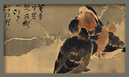
Of course, the basis of the Lingnan school lies in a demonstrable ability to depict nature at first hand, and includes not only landscapes but, naturally, animals as well. The great masters of the Lingnan school all love animal themes. Chao Shao-ang, a master Au has admired all his life, created marvelous works featuring birds, flowers, plants, and insects. Xu Beihong once expressed his admiration for these in verse: "There is a worthy heir to the southern tradition/ Gentleman Chao captures the very spirit of birds and flowers." Au's animal paintings are also first-rate. In works like a bird of prey sighting its victim, a tiger taking a backward glance as it walks away from the viewer, or a lazing lion, every aspect-the feathers, skin, or fur, the expressions in the eyes, the postures-conveys the essence and vitality of the subject. When Au was first doing animal paintings, he would go to the zoo and sit in the same place all day, or even go several days in a row to capture all the moods and postural nuances of, say, a tiger. His ability has been cultivated in this manner, brush stroke by brush stroke. Recently, despite the overall cooling of the art market, an Au painting of a tiger fetched more than NT$200,000 at auction, proving that his reputation is well deserved.
Au's interest is really engaged when the subject is painting from nature. For him, taking a large sketch book, brush, and ink on boats, in cars, or on foot across rivers and into the mountains is not "work," but fun. Like breathing, it is an integral part of his life. He is very laid-back about these journeys, which reflect his own personality. He goes when he feels like it, and, like his paintings, imposes no frames or borders, but simply lets them evolve as they may.
Transcontinental exhibitions
In February, a 50-year retrospective of Au's work opened at the Pacific Heritage Museum in San Francisco. The exhibition will run for a year. Meanwhile, a two-week show at the Sun Yat-sen Memorial Hall in Taipei in early July features works completed between 1990 and 2000. As Au likes to say, an artist is like a maker of fine wines. He has no need to constantly do something new just for the novelty, but simply has to keep observing, thinking, reading, and creating, and his work will continually improve.
Au's upcoming exhibition is a great opportunity to experience Au's personal style as well as to see the theories of the Lingnan school in practice. Be sure not to miss it!
Au Takes Painting Out of the Clouds
So he decided to draw something edible.
With ink, water and paper he created in one hour a cute, short, whiskered man selling freshly baked shao bing (a special kind of Chinese pancake). Beside the man, in graceful calligraphy, Au wrote a poem describing his "hunger, coldness and yearning for a hot cake."
Like this painting, titled "Wu Dalang selling pancakes," Au's works now on show at the National Art Museum of China (NAMOC) reveal to visitors a wise, cheerful and easily accessible artist, not at all like the ink paintings of some other artists which seem too lofty to comprehend. The review exhibition at NAMOC in Beijing, which Au launched to celebrate his 70th birthday, includes 112 representational landscapes, flower and bird paintings, figure paintings and calligraphy that he created over a span of 50 years.
Au enjoys his life-long flirtation with ink and water. The delicate patterns and balances between light and shade convey a liveliness, elegance and sublimity, remarked Yang Lizhou, curator of the museum.
Yang said it is the tradition of Lingnan School artists (including Au) to embrace the contemporary in aesthetic taste and to shuck off hackneyed styles and subject matter that have fettered Chinese painting for centuries. The exhibition is the second major showing of Lingnan School art at the museum since re-opening after its refurbishment last year.
The first, held last November, featured works of the school's master painter Fang Kending (1901-75).
Fang, a student of the school's founder Gao Jianfu (1879-1951), is internationally known as the leader in the reform of Chinese figure painting, which started in the 1930s, ahead of even Xu Beihong (1895-1953) and Jiang Zhaohe (1904-86). Born in 1935 in south China's Guangdong Province, Au is the representative of a later generation of Lingnan School artists than Fang. The school, as the name implies (Lingnan means "south of the mountains"), has its roots in the south of the country, in Guangdong, especially in the provincial capital Guangzhou.
It established itself as one of the three major schools in the tide of reform in Chinese painting at the beginning of the 20th century, the other two being the Beijing-Tianjin School and the Shanghai School. At a time when traditional Chinese painting had almost been driven into a dead end by its 800-year-old emphasis on an aloofness towards worldly affairs, Gao Jianfu (1879-1951), Gao Qifeng (1889-1933) and Chen Shuren (1884-1948), co-founded the Lingnan School.
Since the three masters, generations of the school's artists, with a youthful passion and boldness, have been "experimenting with the problem of finding an East-West synthesis in painting and developing a consistent solution," remarked renowned artist Fu Baoshi (1904-65).
"Whatever makes a moving, effective picture, we will adopt. We seek to renovate, to create and recreate constantly. We hope that the day will come when people will understand the true nature of the Lingnan School," said Au. "A school should never be defined by certain fixed techniques. Our school is defined by an idea for which the founders were constantly criticized by their contemporaries, and by which their followers have been endowed with the courage to create," he added.
Au has been widely recognized as the leader of his generation of the school's artists. He was student of artist Zhao Shao'ang (1905-98), and is the Huagang Chair Professor of Art at the University of Chinese Culture in Taipei. His works have been prized since the 1950s by public and private collectors around the world, including the British Museum, the San Diego Museum of Art in California, the Asian Art Museum of San Francisco and the Musee Cernuschi in Paris. He has also held solo shows at more than 10 art museums of world importance.
Au likes to apply ink tones and color washes directly while sparing the use of outline, thus achieving an emphasis on dimension and distance.
He says, painting is "just one of the pleasures that one seeks from life." He is also a poet in both Chinese and English, and a calligrapher and connoisseur of Chinese arts.
A piece on show titled "Yuping Peak of Huangshan Mountain" illustrates how Au takes pleasure in his art. It snowed in 2000 on the mountain where Au had gone on a sketching tour, and he set down the scene on a fan he had with him.
"Snowflakes fell onto the fan and diffused the fresh ink, creating a delicate scent. It was one of the most lovely and memorable moments of my life," he said. Once a week for the past 30 years Au has driven to Yangming Mountain in Taipei, where his university lies. "At dusk I drive down the mountain towards the Danshui River at its foot. I have drawn this familiar scene more than 20 times, but it seems to be impossible to capture the spirit of the scene on paper," he said.
(China Daily March 22, 2004)
|
||||||||||||||||||||||||||||||||||||||||||||||||||||
|
||||||||||||||||||||||||||||||||||||||||||||||||||||








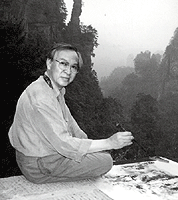 Among
the masters of traditional Chinese painting in Taiwan, the name of Au
Ho-Nien, from the Lingnan school of painting, ranks only behind those of
the greats such as Chang Ta-chien, Huang Chun-pi and Pu Hsin-yu.
Among
the masters of traditional Chinese painting in Taiwan, the name of Au
Ho-Nien, from the Lingnan school of painting, ranks only behind those of
the greats such as Chang Ta-chien, Huang Chun-pi and Pu Hsin-yu. 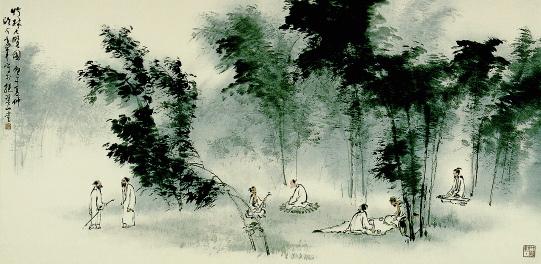
 No
room for complacency
No
room for complacency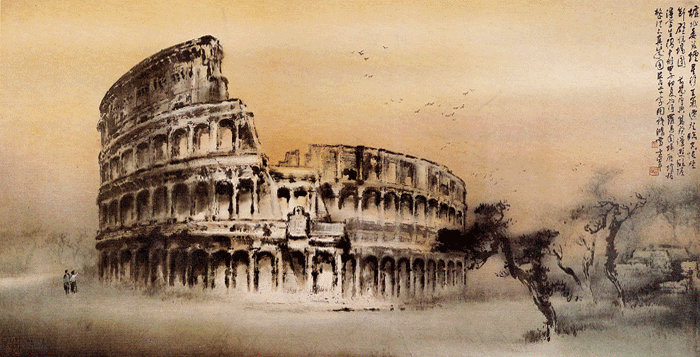 Au
may not be the most senior of the third generation Lingnan school artists,
but with his artistic accomplishments, his years of teaching at Chinese
Culture University, and his wide body of personally trained pupils, he has
helped the Lingnan school to attain special prominence in Taiwan and
become internationally renowned.
Au
may not be the most senior of the third generation Lingnan school artists,
but with his artistic accomplishments, his years of teaching at Chinese
Culture University, and his wide body of personally trained pupils, he has
helped the Lingnan school to attain special prominence in Taiwan and
become internationally renowned.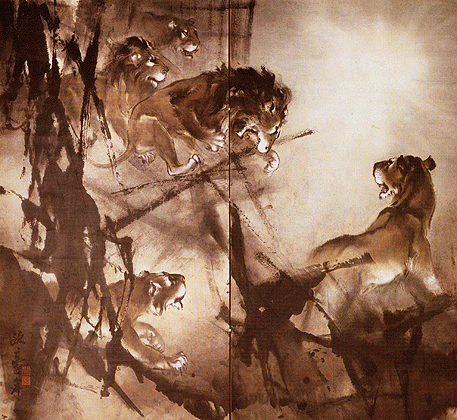 Au
Ho-nien, master of Chinese painting, felt too hungry to go on after
lecturing for two hours without having had his breakfast at the University
of Chinese Culture in Taipei.
Au
Ho-nien, master of Chinese painting, felt too hungry to go on after
lecturing for two hours without having had his breakfast at the University
of Chinese Culture in Taipei.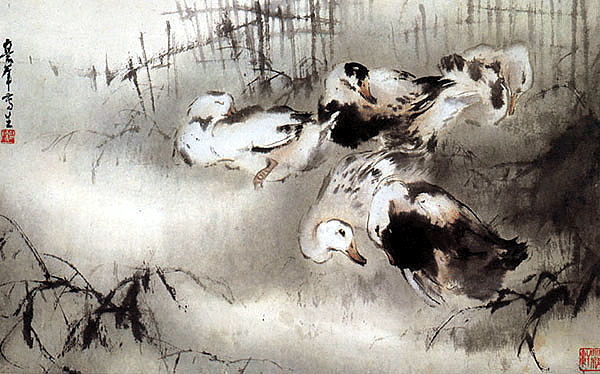 Easily
recognizable elements of Au's style include broken textural strokes and
the dry rubbing effect of a partially dry brush, which are harmonized with
the techniques of water and pigment infusion.
Easily
recognizable elements of Au's style include broken textural strokes and
the dry rubbing effect of a partially dry brush, which are harmonized with
the techniques of water and pigment infusion.