|
|
LINGNAN
SCHOOL |
THE HISTORY
|
THE ROOTS
|
JAPANESE CONNECTION
|
LINGNAN MASTER
|
THE ROOTS OF LINGNAN SCHOOL
The Qing dynasty closed China to maritime trade in 1757, just at the
moment when European nations were expanding their international commerce.
Guangzhou (Canton) was the only legal port for trade between China and the
outside world until 1843. This southeastern region, which includes modern
Guangdong province, was commonly referred to as Lingnan, and produced some
of the most important political thinkers of the late nineteenth and early
twentieth centuries, including Kang Youwei and Liang Qichao, who advocated
replacing the imperial system with a constitutional monarchy, and Sun
Yat-sen, who established China's first republic in 1911.
The development of a Cantonese manner of painting began in the nineteenth
century, but did not attain national visibility and a distinctive style
until the first part of the twentieth century. The leader of the Lingnan
School of painting was Gao Jianfu (1879-1950?), who joined the Alliance
Society (Tongmeng hui), founded by Sun Yat-sen in 1905 to overthrow the
emperor. After 1911 he devoted himself instead to a revolution in art. In
his painting, publications, and teaching, he promoted the development of a
New National Painting (xin guohua). He and his followers, most notably his
younger brother GAO Qifeng, combined the local style with elements of
Western and Japanese realist painting to create an art that they hoped
would be more accessible to the citizenry of China's new republic than the
literati painting of the past.
|
The Roots and
Branches of the Lingnan school of Painting |
|
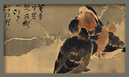
Song guangbao
and meng jinyi
( Center China bird and flower painters brought to Canton in
retinue of imperial government official, first half of 19th
century
|
|
 |
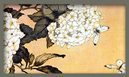
JU LIAN
JU CHAO
( 1827 - 1904 )
( Innovative professional flower painter and teacher of these
artists around 1900 )
|
|

|
|
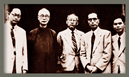
GAO JIAN-FU
1987-1951
GAO QI-FENG 1889-1935
CHEN SHU-REN 1883-1949 |
|
|
The three
founders of the Lingnan School Study in Japan, 1906-1911, and
participate in Republican Revolution of 1911.
|
|
 |
|
GAO JIAN-FU
1987-1951
Disciples at Spring Slumber Studio
in Canton, 1924-1937 |
GAO QI-FENG
1889-1935
Disciples at Heavenly Breeze
Pavilion in Canton, 1929-1935 |
CHEN SHU-REN
1883-1949 |
|
In China Hong
Kong, Taiwan & Overseas |
In China Hong Kong
& Overseas |
one direct Follower |
|
GUAN SHAN-YUE
LI XIONG-CAI
FANG REN-DING
SU WON-ONG
LI FU-HONG
Ven. Hiu Wan
SITU QI
YANG SHAN-HEN |
HUANG SHAO-QIANG
CHAO SHAO-ANG
HANG HUAN-WU
BAO SHO-YOU
ZHANG KUN-YI
ZHOU YI-FENG
HO QI-YUAN
YEH SHAO PIN |
Low Chun-Jo
|
|

|
|
The
Lingnan School of painting |
|